Current Issue
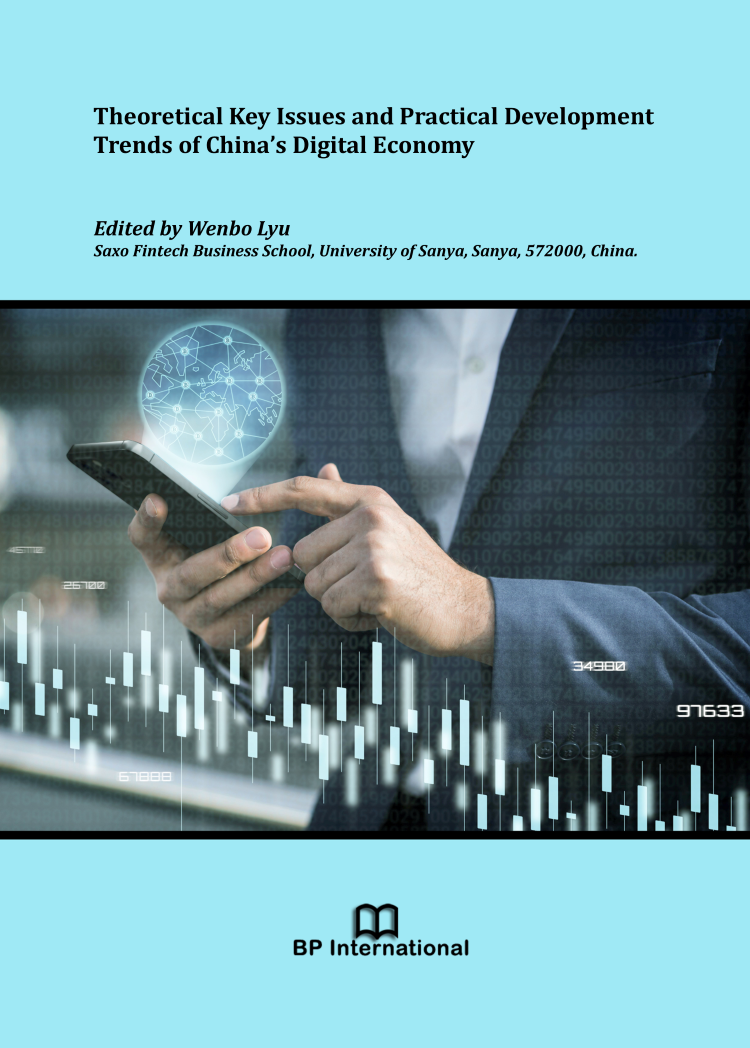
Edited by
Wenbo Lyu
Saxo Fintech Business School, University of Sanya, Sanya, 572000, China.
ISBN 978-93-48388-89-6 (Print)
ISBN 978-93-48388-60-5 (eBook)
DOI: https://doi.org/10.9734/bpi/mono/978-93-48388-89-6
China’s digital economy has led to disruptive innovation and improvement in productivity, getting rid of over-reliance on heavy industry, breaking the trap of middle-income countries, laying the economic foundation for Chinese modernization, achieving overtaking in corners, and making China green and stable. It is a powerful economic power in the world. The integration of the digital economy with major industries and the innovation of the digital economy in various economic regions have promoted the development of new productive forces, especially in industrial upgrading, rural revitalization, institutional innovation, talent training, tourism development etc., and have achieved great success.
Based on the background of industrial digitization and digital industrialization, my team began to conduct in-depth research on the successful experience of China’s digital economy and the focus of the development of new productivity. It also brings together the phased research results into this book, hoping to make a certain contribution to the development of social sciences in the world.
This book is mainly divided into three parts. The first part (from chapter 1 to 4) discusses some key theoretical issues, especially the relationship between digital RMB and digital economy, free trade and digital economy, and digital education and digital economy. The second part (from chapter 5 to 17) is technical articles at the application level, which mainly shows the digital significance, methods and models in key areas in the digital economy era such as financial field, entrepreneurship, education, etc. The last part (from chapter 18 to 37) is an empirical analysis of the case, relying on factual data to prove that the combination of the digital economy and various industries has produced important cases that promote social progress.
Our research scope is mainly China, including provinces and cities. The research content covers most areas of the digital economy, ranging from industry to finance. The depth and innovation of the research are mainly digital theory and case analysis under industrial thinking. We all know that there is no end to social science research in China. Our research is just the tip of the iceberg. Broader and deeper research is worthy of our lifelong efforts.
Finally, as the editor-in-chief of this book, I need to thank my team members. They are the authors of various chapters and also my friends. Their names are Jinfang Li, Yingbo Lyu, Xuehai Lyu, Jiacheng Lyu, Jiming Yang, Minqi Zheng, Zhennan Wang, Jiajun Yin, Yuxin Wang, Chenxi Min, Hao Su, Daliang Gao, Guanghua Chen, Qianwan Xu, Zhiyao Cao, Guangmin Zhu, Aopeng Li, Zhehao Lei, Yueting Liu, Baoshuai Liu, Yiqian Wang, et al.
At the same time, I would also like to thank my family members and Sanya University for your strong support. Without you, it would be difficult for my work to go so smoothly. Notably, this book is funded by Hainan Provincial Social Science Fund Project [HNSK(QN)23-98] and the Key Laboratory of Financial Innovation and Multi-Asset of the Key Laboratory of Philosophy and Social Sciences of Hainan Province in China, the special training project for young and middle-aged teachers in scientific research at Sanya University (USYJSPY24-38), the special training project for young and middle-aged teachers of Sanya College (SYJPZQ2024045).
Media Promotion:
- Chapter 01
- Chapter 02
- Chapter 03
- Chapter 04
- Chapter 05
- Chapter 06
- Chapter 07
- Chapter 08
- Chapter 09
- Chapter 10
- Chapter 11
- Chapter 12
- Chapter 13
- Chapter 14
- Chapter 15
- Chapter 16
- Chapter 17
- Chapter 18
- Chapter 19
- Chapter 20
- Chapter 21
- Chapter 22
- Chapter 23
- Chapter 24
- Chapter 25
- Chapter 26
- Chapter 27
- Chapter 28
- Chapter 29
- Chapter 30
- Chapter 31
- Chapter 32
- Chapter 33
- Chapter 34
- Chapter 35
- Chapter 36
- Chapter 37
Contents
Services:
1. Professional review, editing and plagiarism checking.
2. Professional cover-page design and typesetting.
3. Specialized English editing and proofreading
4. Digital Object Identifier (DOI) allotment.
5. ISBN number (online and print version)
6. Online publication of the book and printing in the press.
7. Royalty: (80:20) profit sharing between author and publisher from the sale of books. Authors will get 80% of the profit and Publisher will get 20% of the profit.
8. Normally Books will be closed access to increase the possibility of sale and authors will retain the copyright of the book chapter/ books. Special requests of open access books can also be considered in case of complete book publication.
