Current Issue
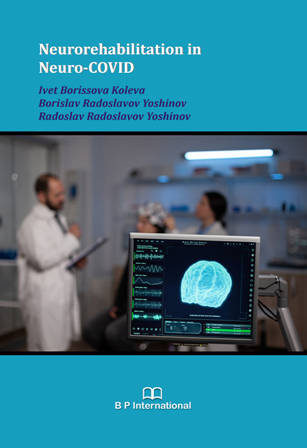
Author(s)
Ivet Borissova Koleva
Medical University of Sofia, Bulgaria, Multi-profile Hospital for Long-term Care and Rehabilitation “Serdika” with Medical Center for Robotic Neurorehabilitation “ReGo”, Bulgaria and National Heart Hospital, Cardiorehabilitation Department, Sofia, Bulgaria.
Borislav Radoslavov Yoshinov
Medical Faculty, Sofia University, Sofia, Bulgaria.
Radoslav Radoslavov Yoshinov
University for Library Studies and Information Technologies UNIBIT, Sofia, Bulgaria.
ISBN 978-81-19315-63-5 (Print)
ISBN 978-81-19315-62-8 (eBook)
DOI: 10.9734/bpi/mono/978-81-19315-63-5
The pandemic of coronavirus disease (COVID) 19 provoked many health problems in all countries, including Bulgaria. Severe acute respiratory syndrome coronavirus 2 (SARS-CoV-2) includes symptoms with diverse levels of severity of different systems: respiratory, cardiovascular, nervous, etc.
All these symptoms altered the quality of life of patients. In every clinical case, rehabilitation is needed – during or after the acute stage, and in cases of sequelae of severe and critical forms of COVID: respiratory alterations, cognitive and neurological disorders; deconditioning; critical illness-related myopathy and neuropathy; dysphagia; joint stiffness and pain; psychiatric problems.
Many acute and chronic neurological issues were considered as consequences of COVID-19: ischaemic stroke, inflammatory and neurodegenerative disorders (encephalomyelitis, leucoencephalitis, Guillain-Barre syndrome and chronic demyelinating polyneuropathy, relapses of Multiple sclerosis, Parkinsonism; cognitive impairment, post-intensive care syndrome (PICS), Memory, attention and sleep problems; Brain fog, Post-traumatic stress syndrome, Depression and Anxiety.
Neurological manifestations of coronavirus are considered a public health emergency of international concern.
Physical and Rehabilitation medicine (PRM) may be useful for functional recovery and amelioration of autonomy in activities of daily living (ADL).
Elements of the PRM algorithm or neurorehabilitation (NR) algorithm include: kinesitherapy (KT: exercises, massage), preformed physical modalities (electric currents, magnetic field, light), ergotherapy (ET: activities of daily living), thermo/balneo/peloido-therapy (paraffin, mineral waters, therapeutic mud, fango), patient education (medicaments, physical activity, diet, control of risk factors).
Ultimately, contemporary information and communication technologies (ICT) were introduced in the rehabilitation practice. We use Exoskeletons, virtual reality, robotic rehabilitation with Locomat (Hocoma system for balance and gait training) and ThyroMotion system (for grasp training). We consider introduction of robotics as necessary tool in the process of neurorehabilitation.
Services:
1. Professional review, editing and plagiarism checking.
2. Professional cover-page design and typesetting.
3. Specialized English editing and proofreading
4. Digital Object Identifier (DOI) allotment.
5. ISBN number (online and print version)
6. Online publication of the book and printing in the press.
7. Royalty: (80:20) profit sharing between author and publisher from the sale of books. Authors will get 80% of the profit and Publisher will get 20% of the profit.
8. Normally Books will be closed access to increase the possibility of sale and authors will retain the copyright of the book chapter/ books. Special requests of open access books can also be considered in case of complete book publication.
