Visible Light-activated 2-Phenyl Indole (PI)/TiCl\(_4\) Complexes for Atmospheric CO\(_2\) Capture and C\(_6\)-C\(_{17}\) Organic Synthesis via Hydroxyl Radical Synergism
DOI:
https://doi.org/10.9734/bpi/cbrp/v1/3722Keywords:
Photosynthesis, organotitanium, CO\(_2\) and H\(_2\)O capture, CO\(_2\) reduction, living chemical system, photocatalysis, OH radicals, photosynthetic productsAbstract
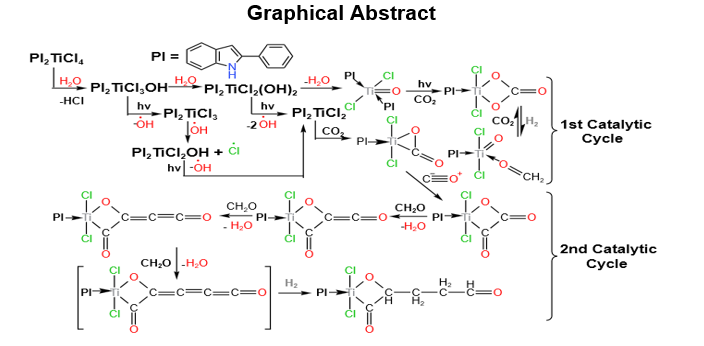
Preferred systems are catalysts that operate away from equilibrium, continuously supplied with energy and materials from inexhaustible sources such as sunlight, air, and water. This concept underpins artificial photosynthesis (AP). A novel self-organized chemical "living" system is presented that mimics natural photosynthesis by capturing CO2 and H2O from the atmosphere under ambient conditions. Using 2-phenyl indole (PI) and TiCl4 complexes activated by visible light, this system autonomously reduces CO2 with H2O protons to produce long-chain oxygenated hydrocarbons up to C17. The process begins with hydrolyzed PI/TiCl4 complexes reacting with CO2 to form organotitanium carbonates, with the 2:1 PI/TiCl4 ratio proving most effective. Visible light reduces Ti+4 to Ti3+ and Ti2+, generating hydroxyl radicals, which play a critical role in the reduction of CO2 to CO, H2CO, and CH3OH. These intermediate further couple to form C6 to C9 \(\alpha\)-carboxylic acid-\(\omega\)-aldehyde compounds, which serve as feedstocks for the subsequent synthesis of longer carbon chains (C12 to C17) through a radical mechanism. The system facilitates ligand exchange between PI and donor molecules, forming adducts involved in the photocatalytic process. Additionally, PI oligomerization contributes to the formation of functional oligomers. Over two dozen intermediates and products were identified using MALDI-TOF, 13C NMR, and IR spectroscopy, highlighting the complexity of the reaction network. This catalytic system uniquely integrates organotitanium chemistry and hydroxyl radical pathways, autonomously capturing CO2 and humidity from the atmosphere while harnessing solar energy to produce valuable long-chain oxygenated hydrocarbons. This prototype offers a foundation for exploring broader applications and enhancements using other metals and ligands.