Experimental Investigation on Operative Utilization of the Feasible Anion Exchange Membrane BIII for Sorptive Exclusion of Acid Orange 7 from Hydrated Media
DOI:
https://doi.org/10.9734/bpi/rdcbr/v6/613Keywords:
Sorption, anion exchange membrane BIII, acid orange 7, freundlich isotherm, linear, nonlinear isotherm modelsAbstract
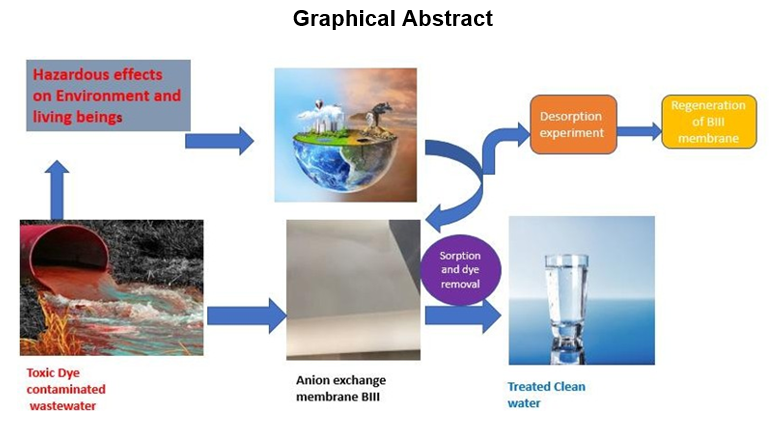
In the present study, a commercial BIII membrane was exploited for the exclusion of anionic dye AO7 from a watery medium. The impact of constraints such as temperature, contact duration and sorbent dose on the exclusion of dye from aquatic medium was probed at ambient temperature. Anion exchange membranes have drawn a lot of interest because of their capacity to provide profitable and fuel-efficient commercialization while simultaneously eliminating dangerous dye pollution from industrial wastewater. This illustrates how anion exchange membrane BIII can remove acid orange 7 dye from aquatic environments. The sorbent's surface characteristics and the presence of discrete operating groups were identified using SEM and FTIR investigations. Numerous constraints on AO7 exclusion in an aquatic environment, such as contact duration, temperature, sorbent dose, and starting dye concentration were also scrutinized. For the purpose of assessing kinetics, Liquid film diffusion, Elovich, Lagergren first-order, Bangham, pseudo-second-order, and modified Freundlich models, were employed. These findings imply that the AO7 dye sorption onto the BIII membrane is well controlled by the liquid-film diffusion process and that the sorption comprehends pseudo-second-order kinetics with an utmost value of R2(0.99). To evaluate tentative data, multiple linear and nonlinear isotherm models were utilized. Freundlich isotherm was found to be in excellent agreement with sorption data. Thermodynamic specifications, such as a change in Gibb’s free energy, enthalpy, and entropy, for dye sorption on the anion exchange BIII membrane were optimized between 308-338 K to maximize AO7 dye removal. Since \(\Delta\)Go is negative and, \(\Delta\)Ho and \(\Delta\)So are positive, inferred that the sorption is spontaneous and endothermic. Anion exchange membrane BIII was effective for up to four successive cycles without losing its competence. Anion exchange membrane BIII was effective for up to four successive cycles without losing its competence so that it can be utilized as a promising sorbent for the exclusion of AO7 dye from wastewater.