New Protein Settings to Support In vivo Antimalarial Activity in Plasmodium berghei Infected Mice after Garlic-Arteether Therapy: A Recent Study
DOI:
https://doi.org/10.9734/bpi/ramb/v2/9007FKeywords:
Plasmodium berghei, malaria, serum protein, peptidyl-prolyl-cis-trans isomerase A, over expression, misfolding, protectionAbstract
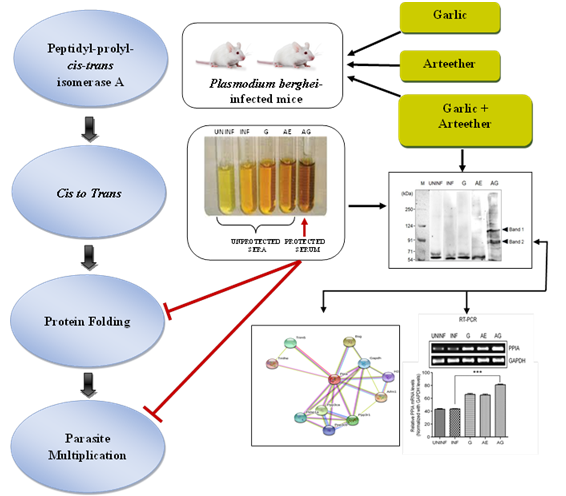
WHO is bringing many Control and eradication strategies for pursuing malaria elimination in endemic nations. These technical challenges necessitate the development of integrated approaches, among which safe and effective malaria vaccines could be a critical tool. Due to lack of malaria vaccine, the control efforts relay mainly on the Chemotherapy, especially treatment based on traditional medicine has become very popular. Since parasite has developed resistance to all existing antimalarials, the control efforts relay heavily on treatment with new antimalarial agents preferably acting on newer targets. Garlic is one such traditional medicine for curing many diseases in Ayurvedic Science. This chapter highlights the antimalarial activity of garlic in combination with artemisinin through a host parasites specific protein, peptidyl-prolyl-cis-trans isomerase A (PPIA) in the protected serum. It has been demonstrated to mediate specific protein folding processes in both in vitro and in vivo settings, including the interconversion of the cis and trans. According to the study, overexpressed PPIA may cause parasite proteins that are essential for parasite multiplication to misfold, which could result in parasite mortality or protect samples that have been treated with a combination of drugs.
Graphical Abstract