Tribological Evaluation of Turbostratic 2D Graphite as Oil Additive: A Recent Study
DOI:
https://doi.org/10.9734/bpi/ntpsr/v4/15846DKeywords:
Turbostratic graphite, lubricant additive, solid lubricant, friction, wear, nanoparticleAbstract
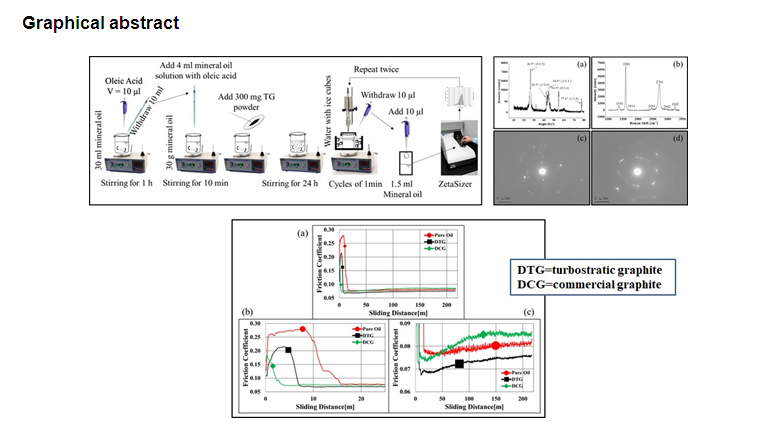
Powder technology was employed in this study to create Fe-SiC composites. SiC particles act as precursors to generate a considerable amount of turbostratic graphite scattered throughout the composite matrix. Thermo-Calc® software was used to determine the temperature and composition range for stabilising the graphite phase in iron with a high yield. To assess the potential of the recovered turbostratic 2D graphite particles as a lubricating oil additive, they were dispersed in mineral oil. Raman spectroscopy and transmission electron microscopy (TEM) were used to analyse the structure and morphology of the extracted graphite, revealing the highly disordered character of turbostratic graphite. Compared to pure mineral oil and mineral oil with commercial graphite particles added, reductions in the friction coefficient and wear rate of a tribological pair were detected. Because of the misorientation and increase in interplanar distances in turbostratic 2D graphite, there is little interaction between these atomic planes, resulting in a low friction coefficient and lower wear rate.