Application of Medicinal Plant Synthesized Silver Nanoparticles on Seedling Growth and Antimicrobial Efficacy- A Holistic Approach
DOI:
https://doi.org/10.9734/bpi/cimms/v4/8225FKeywords:
Silver nanoparticles, phytochemical, seeding growth, antibacterial, agroecosystemAbstract
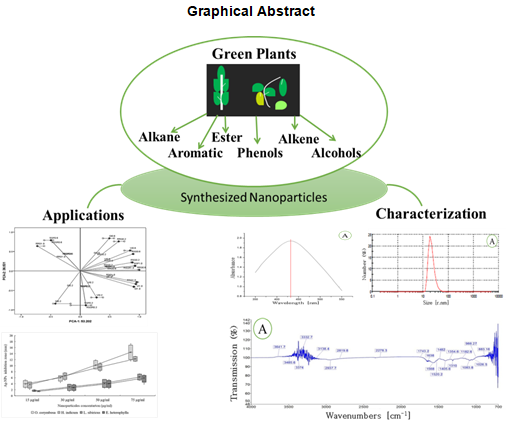
Silver nanoparticles (AgNPs) were synthesized from collected leaf extracts of Oldenlandia corymbosa, Euphorbia heterophylla, Heliotropium indicum and Leonurus sibiricus plants. Synthesized AgNPs were confirmed and characterized by UV–VIS spectroscopy, Particle Size Analyzer (PSA) and Fourier-Transform Infrared Spectroscopy (FTIR) analysis. We investigated the effect of AgNPs on the seedling assessment of Vigna radiata and the antibacterial efficacy of pathogenic bacterial species. Seeds treated with concentration variation of synthesized AgNPs showed 0.6 gm/mL concentration have a higher seedling growth activity compared to control seeds. Furthermore, bactericidal efficacy was higher in Gram-negative bacterial pathogens than in Gram-positive bacteria at 75 µg/mL concentration. Thus, biobased nano-treated seeds were used in agricultural fields for seedling exposure instead of chemical fertilizers to reduce environmental hazards and improve the sustainable agricultural ecosystem. Also, these labs synthesized biobased silver nano is used to prevent pathogenic bacterial infection.