The Genetic Diversity of Triturus vittatus vittatus (Synonym Ommatotriton vittatus) Along the Southern Border of its Distribution
DOI:
https://doi.org/10.9734/bpi/arbs/v2/5918BKeywords:
Salamander, Triturus vittatus vittatus, DNA markers, AMOVA, genetic variation, populationAbstract
The aim of this chapter is to investigate the genetic diversity of Triturus vittatus vittatus (synonym Ommatotriton vittatus). This salamander species is found in different breeding sites throughout the southern border of its distribution. Two mitochondrial DNA markers, 12S and 16S, and the nuclear rhodopsin gene (RHO) were used to examine the genetic variations in this species. AMOVA analysis was conducted to investigate the distribution of the variation and differential connectivity among populations, regions, and populations within regions. This analysis of the 163-bp RHO DNA sequence did not reveal any significant genetic variation among the different populations in the various habitats according to detection of population differentiation. In contrast, comparison of 12S rRNA (357 bp) and 16S rRNA (521 bp) revealed high variation among the regions for the different populations. AMOVA showed high dissimilarity between the breeding sites of newts at the southern border of their distribution.
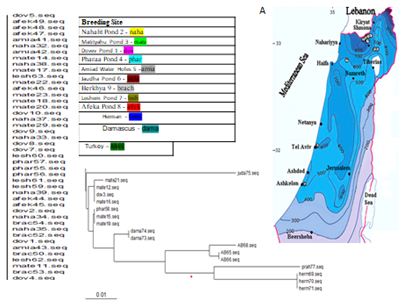
GRAPHICAL ABSTRACT
Variation of mitochondrial 16S rRNA in Triturus vittatus vittatus in different habitats at the southern limit of its distribution.